WELCOME TO OUR BLOG

We're sharing knowledge in the areas which fascinate us the most
click

CT Scanner Installation Requirements: A Comprehensive Guide

By Fatali med January 7th, 2026 455 views
Installing a CT scanner is a complex process that requires careful planning to ensure safety, optimal performance, and regulatory compliance. This guide covers key aspects including room size, electrical needs, radiation shielding, and environmental controls. Always consult a qualified radiation physicist, electrician, structural engineer, and local authorities for site-specific requirements.
CT Scanner Installation Requirements: A Comprehensive Guide

Installing a CT scanner is a complex process that requires careful planning to ensure safety, optimal performance, and regulatory compliance. This guide covers key aspects including room size, electrical needs, radiation shielding, and environmental controls. Always consult a qualified radiation physicist, electrician, structural engineer, and local authorities for site-specific requirements.

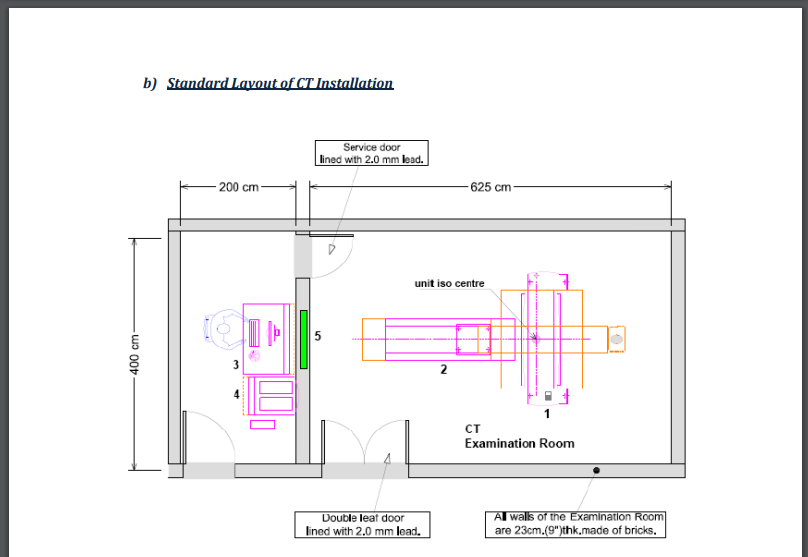
CT scanner room layout example
Picture excerpted from: https://www.ctmrihub.com/blog

1. Room Size and Layout

The scan room must accommodate the gantry, patient table, control console, and allow safe movement.

  • Minimum Dimensions: 20 ft × 24 ft (6m × 7.3m) or 27 ft × 15 ft (8.2m × 4.6m) for the exam room. Total suite often 375–650 sq ft (35–60 sq m).
  • Ceiling Height: 9–10 ft (2.7–3m) for maintenance access.
  • Layout Tips: Include a large leaded glass control window (min. 48" × 36"), wide doors (≥4 ft), and emergency pathways.
Tip: Use CAD planning to ensure 2–3 ft clearance around the scanner for technicians.

2. Electrical Requirements (Voltage and Power)

CT scanners require stable, high-capacity power.

  • Voltage: 208–480V, 3-phase AC (dedicated circuits mandatory).
  • Power Capacity: 50–150 kVA (e.g., 80–100 kVA for 64-slice systems).
  • Other: Proper grounding, emergency power-off (EPO) buttons, and backup generator recommended.
For Professionals: Test voltage stability before installation to prevent tube damage.

3. Radiation Protection (Shielding)

Shielding prevents scatter radiation exposure (follow ALARA principles).

  • Materials: Lead-lined walls (0.5–1.0 inch), doors (0.25–0.5 inch), floors/ceilings as needed.
  • Design Basis: Workload, occupancy, and isodose maps from manufacturer.
  • Additional: Leaded glass windows, sealed cable penetrations, warning signs.

4. Floor Load and Stability

Scanners weigh 1–3 tons; floors must support without subsidence or vibration.

  • Load Capacity: 150–300 lbs/sq ft (750–1,500 kg/sq m) reinforced concrete.
  • Stability: Structural survey recommended, especially in older buildings.

5. Environmental Conditions

Stable environment prevents equipment failure.

Planning a CT Scanner Purchase or Installation?

Fatali-Med provides full support including site planning, installation, and training.

Contact Us for Expert Guidance & Quotes

Always refer to manufacturer site planning guides and local regulations. This information is based on industry standards (NCRP 147, AAPM).

How Hospitals Define Technical Specifications for Fixed X Ray Machines,Fatali Medical equipment
Previous
How Hospitals Define Technical Specifications for Fixed X Ray Machines
Read More
How to Choose a Hospital CT Scanner in 2026,Fatali Medical equipment
Next
How to Choose a Hospital CT Scanner in 2026
Read More

CONTACT US

If you have any queries, get in touch today! Don't hesitate. We try to take the extra step for our customer satisfaction.
Name*
Country *
WhatsApp*
Please input your WhatsApp for more convenient contact,Thank you!
Email*
Message*
Leave a message
Name*
Country *
WhatsApp*
Please input your WhatsApp for more convenient contact,Thank you!
Email*
Message*
We use Cookie to improve your online experience. By continuing browsing this website, we assume you agree our use of Cookie.
Message Us