Buying a fixed X-ray machine is a big step for any clinic or hospital.
Many buyers hesitate not because of price—but because they’re unsure about room size, power supply, and installation requirements.
The good news?
Most concerns are simpler than they look. Let’s break them down clearly.
One of the most common questions we hear is:
“Is my X-ray room big enough?”
In most cases, yes.
A typical fixed X-ray room usually needs:
Minimum room size:
Around 18–25 m² (depending on layout and local regulations)
Ceiling height:
Usually ≥ 2.6 m
Standard layout includes:
X-ray tube stand
Patient table or wall bucky
Control console
Shielded operator area
💡 Tip:
Modern floor-mounted and wall-mounted X-ray systems are designed to be compact and space-efficient, especially for clinics upgrading from CR or older analog systems.
If space is limited, a compact floor-mounted X-ray machine can often fit where older systems couldn’t.
Another big concern is power supply.
Here’s the reality:
Power range:
Most fixed X-ray machines operate at 30–65 kW
Power supply:
Single phase or three phase (model dependent)
Stable voltage is more important than high voltage
Backup power:
Not mandatory, but recommended in regions with unstable electricity
⚠️ Many buyers overestimate power complexity.
Modern generators are designed to work reliably in developing regions, including Africa, the Middle East, and Southeast Asia.
Before purchase, suppliers should confirm:
Available voltage
Phase type
Room grounding
This avoids surprises later.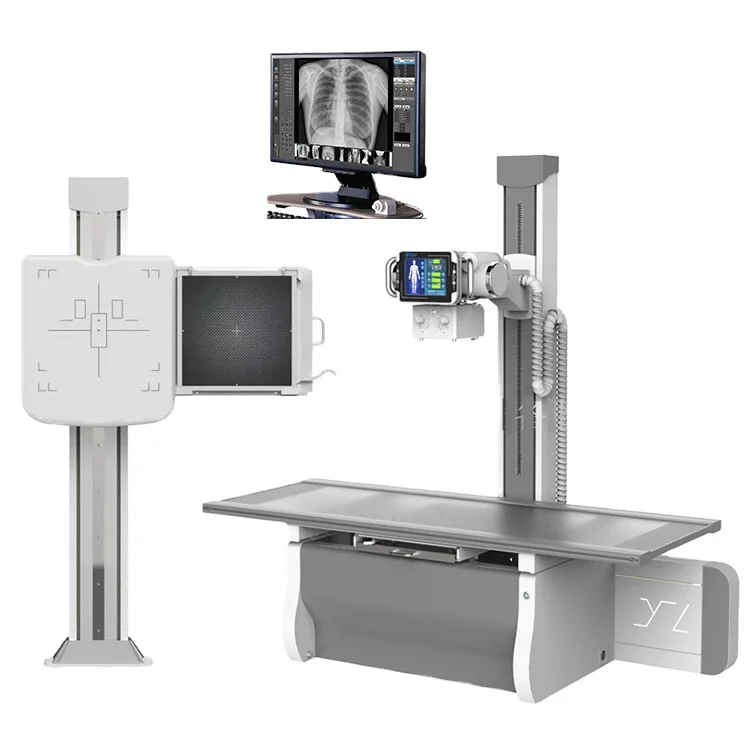
“Installation” often sounds complicated—but it doesn’t have to be.
A standard fixed X-ray installation includes:
Equipment positioning & alignment
Generator and tube calibration
Detector & workstation setup
Basic image testing
Most manufacturers today provide:
Clear installation drawings
Remote online guidance
Step-by-step commissioning support
💡 At Fatali-Med, most installations are completed efficiently with online engineering support, reducing cost and time while keeping quality under control.
Radiation safety is essential—but manageable.
Typical requirements include:
Lead-lined walls or equivalent shielding
Lead glass for observation windows
Shielded control area
Your local radiation authority usually defines exact specs.
A professional supplier can help you calculate shielding thickness based on:
kW level
Room size
Patient volume
This is not guesswork—it’s standard practice.
Budget fear stops many decisions.
A realistic budget for a fixed X-ray setup includes:
X-ray machine (generator + stand + tube)
DR panel (wired or wireless)
Workstation & software
Installation & training
💡 Key point:
A fixed X-ray system often delivers lower cost per exam than portable or mobile units over time—especially for high-volume clinics.
If budget is limited:
Start with a wired DR panel
Upgrade to wireless later
Choose essential functions first
Before you decide, ask yourself:
✔ Do I know my room size and ceiling height?
✔ Is my power supply stable?
✔ Do I want wall-mounted or floor-mounted?
✔ Wired or wireless DR panel?
✔ Does the supplier offer installation guidance and after-sales support?
If these are answered, you’re ready.
A fixed X-ray machine doesn’t have to be risky or complicated.
With the right planning—and the right supplier—it becomes a long-term, stable investment for your imaging workflow.
👉 📩 Get configuration advice via WhatsApp
Tell us your room size, power condition, and budget—we’ll recommend a suitable fixed X-ray solution for your clinic or hospital.
With over 23 years of factory experience, Fatali-Med helps you choose right the first time.


